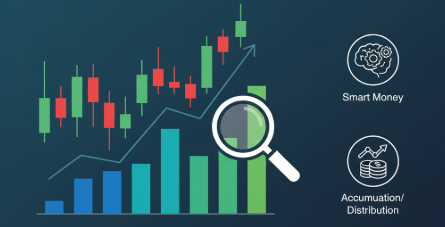
Volume analysis is the cornerstone for spotting institutional flow and aligning trades with smart money rather than fighting it. Large players — mutual funds, FIIs, hedge funds, and algo shops — often accumulate or distribute positions over time to avoid moving prices against themselves. Those activities leave identifiable volume footprints that trained traders can spot.
The key difference for traders is confirmation versus divergence. When price breaks up with expanding volume, the move is confirmed and likely backed by institutional interest. When price rises on declining volume, the move is suspect and often signals weak retail-driven momentum. Turning your approach from guesswork to evidence-based decisions starts with observing these volume-price relationships and reacting to what the smart money is actually doing.
A handful of tools reveal different facets of trade flow and institutional behaviour:
Interpreting volume relative to price action separates signal from noise. A few practical rules:
Institutions leave fingerprints in data. Recognizing those footprints helps you trade with the flow:
Enter when price clears a key level with volume > 2–3x the 20-period average. Place a stop just below/above the breakout and target measured moves or the next high/low. Best during the first two trading hours when institutional participation typically peaks.
When price deviates 1–2 standard deviations from VWAP and volume supports a reversal, trade toward VWAP. Institutions often execute around VWAP; this provides a statistical edge for mean-reversion trades.
When price makes a fresh high/lower low with failing volume, prepare a contrarian setup using tight stops and defined targets at recent structure levels.
Identify unfilled volume nodes after gaps — institutions often gravitate to fill imbalances. Trade toward those nodes with stops at gap extremes.
Accurate volume analysis needs reliable data and capable tools. For Indian markets, start with NSE market data for historical and real-time volume. Professional depth and footprint analysis come from Level II feeds and platforms like Sierra Chart, NinjaTrader, MarketDelta, TradingView (Volume Profile), and broker TWS/Pro platforms.
For tick-level research and institutional signatures use tick/trade data providers rather than tick-count proxies. Make sure your feed reports actual traded volume and includes exchange-level statistics to avoid analytical blind spots.
Table 1: Volume Signal Types (quick reference)
| Signal Type | Description | Trading Action |
|---|---|---|
| Volume Spike | 200–300% above 20-period avg | Follow direction with confirmation |
| Volume Cluster | Concentrated trading at price nodes | Mark as S/R zone |
| Low Volume Breakout | Breakouts with below avg volume | Fade or avoid |
Table 2: Volume Strategy Cheat Sheet
| Strategy | Trigger | Stop | Timeframe |
|---|---|---|---|
| Volume Breakout | Price + 2–3x volume | Below breakout | 15m–1hr |
| VWAP Reversion | Price 1–2 std dev from VWAP + reversal volume | Beyond extremes | 5m–30m |
| Profile Gap Fill | Unfilled volume node after gap | Gap extremes | 30m–4hr |
Trading Shastra Academy teaches volume analysis through hands-on modules: live chart replays, footprint & order-flow labs, VWAP and profile workshops, and internship-style assignments. Students practice identifying institutional footprints, running post-trade analysis, and building volume-based strategies with mentor feedback. Programs include access to demonstration platforms (footprint charts, Level II) and real-case studies of institutional accumulation/distribution in Indian markets.
If you want practical, mentor-led training in volume analysis, check our course details and schedule for live sessions and certification.
Volume analysis studies traded quantity to infer participant behaviour. "Spot smart money" means detecting institutional positioning earlier than retail, because institutions leave volume footprints when accumulating or distributing.
Real breakouts show volume > 2–3x the 20-period average, occur during active market hours, and hold after the breakout. Fakeouts show low volume, fail to hold the level, and often occur in thin sessions.
Volume Profile, VWAP, OBV, and footprint/time & sales combined with Level II give the strongest institutional perspective. For Indian markets, use official NSE data alongside these tools.
Yes — modern charting platforms include volume profile tools. Focus on high-volume nodes as support/resistance, and practice on liquid names before applying to small-cap stocks.
Prefer exchange feeds (NSE/BSE) and reputable tick/trade providers. Broker Level II feeds or premium platforms deliver the best order-flow and footprint detail.
Ready to read smart money with confidence? Join Trading Shastra Academy for live volume labs, order-flow mentorship, and internship certification.
Explore Volume CourseWeekly Webinar, Every Saturday • 7:00 PM (IST)
Founder & CEO, Trading Shastra Academy
12+ Years • ₹10 Cr Funds Managed
95k+ Instagram • 11k+ YouTube
This webinar is for educational purposes only. Stock market investments are subject to Market risks.