- Sector -2, B Block Noida-201301
- tradingshastraacademy@gmail.com

Option Trading Course in Hindi — Practical Guide & Week-by-Week Roadmap 2025
Option trading lets you buy or sell contracts that give the right — not the obligation — to buy (call) or sell (put) an asset before expiry. Learn practical option setups, key indicators such as IV and OI, and step-by-step risk rules to trade options confidently.
Why Learn Option Trading (in Hindi)?
Options are powerful tools that allow controlled exposure to market moves, provide hedging mechanisms, and enable varied strategies from conservative to advanced. For many Indian learners, learning options in Hindi removes jargon friction and speeds practical understanding. This guide merges two earlier sections into one complete, deep tutorial: what options are, key indicators, core strategies, practical NIFTY / Bank NIFTY examples, risk rules, a week-by-week learning path, and how to choose the right course — all explained in plain language appropriate for Hindi learners (but written here in English for broad publishing).
1 — What Is an Option? Plain and Practical
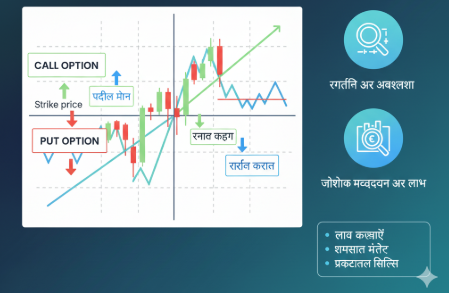
An option is a financial contract that gives the holder the right — but not the obligation — to buy (call option) or sell (put option) an underlying asset at a predetermined price (strike) before or on an expiry date. Buyers pay a premium to sellers (writers) for this right.
-
Call option: Right to buy the underlying at the strike price. Bought when you expect the underlying to rise.
-
Put option: Right to sell the underlying at the strike price. Bought when you expect the underlying to fall.
Payoff behaviour (simple):
-
Buyer of call: Profit = (Spot at expiry − Strike − Premium) if > 0; else −Premium.
-
Buyer of put: Profit = (Strike − Spot at expiry − Premium) if > 0; else −Premium.
Why options differ from stocks:
Options include time value and volatility components. Even if the underlying doesn’t move much, option premiums can change because implied volatility (IV) or time to expiry changes.
2 — Why Learn Option Trading in Hindi?
-
Complex terms like implied volatility (IV), delta, theta, spread, and OI become intuitive when explained in local language and local market examples.
-
Many beginner errors stem from misunderstanding Greeks and option chains — Hindi explanations reduce translation overhead and speed comprehension.
-
A practical Hindi course should use real NIFTY / BANK NIFTY examples, show option chain reading step-by-step, and include live-market sessions (live-market exposure) to apply lessons immediately.
3 — Key Indicators & How to Use Them for Options
You cannot trade options effectively without reading a few core indicators. Learn to combine them rather than trust any one.
3.1 Implied Volatility (IV)
-
What it shows: Market expectation of future volatility priced into option premiums.
-
Usage: High IV → premiums expensive (selling premium may be favourable if conditions suit); Low IV → premiums cheap (buying premium may be attractive ahead of an expected event).
-
Practical rule: Compare current IV to a 30/60/90-day historical IV band for the same instrument. If IV is elevated relative to history, treat premium-selling strategies carefully.
3.2 Open Interest (OI) & Volume
-
OI: Total outstanding contracts at a strike. Large OI near a strike can indicate a support/resistance zone.
-
Volume: Number of contracts traded in a session; a spike signals new interest.
-
Practical use: Rising price + rising OI often validates the trend; rising price + falling OI suggests short covering.
3.3 Relative Strength Index (RSI)
-
Purpose: Measures momentum; helps identify overbought/oversold conditions in the underlying.
-
Use for options: Avoid buying premium with underlying deeply overbought if you expect mean reversion; align directional trades with RSI momentum.
3.4 Exponential Moving Averages (EMA) / Trend Filters
-
Use: 9/21/55 EMAs for intraday and swing context. If price above EMAs and EMAs aligned, bias towards buying calls or bullish spreads.
3.5 Greeks (Delta, Theta, Vega)
-
Delta: Directional sensitivity (approx probability).
-
Theta: Time decay — premium erosion as expiry approaches.
-
Vega: Sensitivity to IV — how premium changes for volatility moves.
-
Practical: For beginners start with delta and theta. For defined-risk spreads, theta decay can be your friend; for directionally bought options, watch vega.
4 — Core Strategies (Start Low Risk → Advanced)
Below are practical strategies with clear purpose and risk profile.
4.1 Defined-Risk Debit Spreads (Beginner friendly)
-
Bull Call Spread: Buy 1 call at lower strike, sell 1 call at higher strike — limited downside and capped upside.
-
Bear Put Spread: Buy 1 put, sell further put — for limited bearish exposure.
Purpose: Learn directional trades with built-in hedges.
4.2 Premium Selling (Intermediate)
-
Iron Condor / Iron Butterfly: Sell two options (call & put) around expected range and buy wings to cap risk.
-
Credit spreads: Sell near strike, buy further strike to limit loss.
Purpose: Income in range markets; requires strong risk controls.
4.3 Event Plays (Straddle/Strangle)
-
Long Straddle: Buy ATM call + ATM put — for large expected move irrespective of direction (high vega sensitivity).
-
Strangle: OTM call + OTM put — cheaper but needs larger move.
Purpose: Capture volatility around earnings, RBI, budget, or policy events.
4.4 Delta Hedging & Arbitrage Concepts (Advanced)
-
Teach small delta adjustments, managing directional exposure while capturing time decay or volatility spreads. Typically part of advanced modules.
5 — Short Practical Examples (NIFTY, BANK NIFTY, Stock)
Practical examples help cement ideas. Use these as templates, not trade calls.
Example A — NIFTY Directional (Bear Call Spread)
-
Context: NIFTY 22,000; downtrend; EMA aligned down, RSI showing momentum.
-
Setup: Sell 22,300 call, buy 22,500 call (defined risk).
-
Rationale: If market stalls below 22,300, you keep net premium; capped risk if breakout occurs.
Example B — BANK NIFTY Event (Long Straddle)
-
Context: RBI announcement expected; IV rising but still below event premium levels.
-
Setup: Buy ATM straddle (ATM call + ATM put), plan pre-defined exit at 40% move or IV reversion.
-
Rationale: Capture large move; limit capital allocation and set exit rules.
Example C — Large Cap Stock (Iron Condor)
-
Context: Stock trading in range; IV moderate.
-
Setup: Sell 1 OTM call and 1 OTM put; buy further wings to cap losses.
-
Rationale: Benefit from time decay while adjusting for range breaks.
6 — Risk Rules & Position Sizing (Practical)
Risk controls are the backbone of long-term survival.
6.1 Position Size Formula (simple)
-
Allocate max 1–2% of trading capital per position for defined-risk trades.
-
For premium selling, treat potential max loss (wing width × lot size − net premium) as the real risk; size accordingly so that this max risk ≤ 1–2% capital.
Example:
Capital = ₹200,000; max per trade risk = 1% = ₹2,000. If iron condor max risk = ₹4,000, reduce lot size or avoid.
6.2 Predefine Rules
-
Stop-loss: Move stop to intraday breakeven after 30–50% favorable move.
-
Max daily drawdown: Stop trading for the day after hitting 3–5% drawdown.
-
Trade frequency: 1–3 quality trades per session; avoid overtrading.
6.3 P&L & Journalling
Record rationale, entry, exit, mistakes and adjustments. Weekly review reveals behavioral patterns and helps refine rules.
7 — Week-by-Week Roadmap (5-Month Detailed Plan)
A progressive path converts knowledge into habit.
Months 0–1: Foundation (Weeks 1–4)
-
Week 1: Option basics, payoff diagrams, contract specs (lot size, tick size).
-
Week 2: Greeks explained with short examples; delta and theta focus.
-
Week 3: Option chain reading: OI, volume, IV, strike selection.
-
Week 4: Simple spreads (bull call, bear put) — paper trading.
Month 2: Indicator Lab (Weeks 5–8)
-
Week 5: IV and its time dynamics; IV rank & percentile.
-
Week 6: OI interpretation, volume & price relationship.
-
Week 7: Momentum indicators (RSI/MACD) for direction.
-
Week 8: EMA & trend filters; aligning strategies to trend.
Month 3: Strategy Lab (Weeks 9–12)
-
Week 9: Defined-risk debit & credit spreads — building and sizing.
-
Week 10: Iron Condor & butterfly setups — adjustments & rules.
-
Week 11: Event strategies: straddles/strangles — pre and post event rules.
-
Week 12: Backtesting basics & building simple rules in spreadsheets.
Month 4: Simulated Live Practice (Weeks 13–16)
-
Week 13–14: Joint live sessions (mentor commentary) — paper/small-size trades.
-
Week 15: Review & adjust strategy rules; journalling habits.
-
Week 16: Trade scenarios: assignment handling and roll-outs.
Month 5: Mentored Live Practice & Transition (Weeks 17–20)
-
Week 17–18: Supervised live market sessions — placing actual small positions under mentor supervision (structured live-market exposure).
-
Week 19: Performance review & individualized feedback.
-
Week 20: Graduation: practical exam, certification, next steps for scaling.
8 — How to Choose the Right Option Trading Course (Checklist + Red Flags)
Use this checklist to evaluate courses claiming to be the “best option trading course in Hindi.”
Course Checklist
-
Live classes + case studies (not only recorded content)
-
Practical trade rules (entries, exits, adjustments)
-
Risk-first approach (position sizing, drawdown rules)
-
Simulated & live-market exposure (stepwise supervised practice)
-
Mentor feedback & small group reviews
-
Clear curriculum & week-by-week roadmap
-
Access to tools (broker charts, option chain access)
-
Verified certification & post-course review support
Red Flags
-
“Guaranteed profits” or absolute promises
-
Lack of clear risk rules or position sizing modules
-
No live-market practice or mentorship sessions
-
High pressure to upgrade or buy add-ons with fuzzy benefits
9 — Tools, Platforms & Practical Setup
You need three pillars: a reliable broker platform, charting tools, and a journal.
Recommended Setup
-
Broker platform: Zerodha Kite / Upstox Pro / Angel One depending on execution needs. Use whichever gives clean option chain and order types.
-
Charting & scanners: TradingView (web), Kite charts, or in-broker scanners for OI & volume alerts.
-
Excel / Google Sheets: For a simple backtest and trade log.
-
Journal: Note setup, emotional state, mistakes, and lessons after every session.
10 — Sample Trade Log — Use Weekly Review
| Date | Instrument | Strategy | Entry | Exit | Size | Net P&L | Reason | Lesson |
|---|---|---|---|---|---|---|---|---|
| 2025-10-01 | NIFTY | Bear Call Spread | Sell 22300C, Buy 22500C | Squared off | 1 lot | −₹500 | EMA down, RSI high | Move stop earlier next time |
Weekly, summarize: winners, losers, repeating mistakes, emotional triggers, and rule changes.
11 — Pricing, Course Delivery & What Mentorship Should Offer
Good courses vary in price and format — what matters is delivery quality.
Delivery Formats
-
Recorded modules: For theory and concept replay.
-
Live webinars: For Q&A and clarified examples.
-
Live trading rooms: Supervised market sessions for application.
-
1-on-1 mentorship: Personalized feedback and tailored improvements.
-
Capstone/assessment: Practical evaluation and certification.
What Mentorship Should Provide
-
Real-time feedback during sessions.
-
Practical notes on position sizing & adjustment.
-
Post-session review and journalling critique.
-
Guidance on transition from small size to scaling responsibly.
12 — Sample Table — Strategy Choice vs. Market Condition
| Market Condition | Strategy Type | Why | Risk Profile |
|---|---|---|---|
| Strong trend | Bull Call / Bear Put spreads | Aligns with trend | Low-medium |
| High IV before event | Long Straddle / Strangle | Capture large move | High (vega dependent) |
| Low IV, sideways | Iron Condor | Time decay income | Medium (defined risk) |
| Range breakout potential | Directional debit spreads | Limited risk directional play | Medium |
13 — Frequently Asked Questions
Q1: How quickly can I learn option basics?
Basics can be learned in 2–4 weeks with focused study and practice; consistent skill building requires months of mentored application.
Q2: Do I need large capital to start?
No — start with defined-risk spreads or paper trading; increase size only after proving a repeatable edge.
Q3: Which indicator to master first for options?
Begin with Implied Volatility (IV): it directly affects option pricing and choice of strategy.
Q4: Are live trading rooms necessary?
Live rooms accelerate learning by showing real execution, immediate mentor feedback, and emotional management under live conditions.
Q5: Can option trading be safe?
Options involve risk; safety comes from proper position sizing, defined-risk strategies, and disciplined risk management.
14 — Conclusion
Options are not mystical — they are tools. Success depends on structured learning, disciplined risk rules, and mentored practice. If you want a complete path:
-
Start with a foundational module on payoff and option chain reading.
-
Practice defined-risk spreads and maintain a journal.
-
Gradually progress to premium selling and event trades under supervision.
-
Use live-market sessions to transition from paper trades to small-size live trades.
-
Keep reviewing performance weekly and iterate rules.
Trading Shastra Academy offers stepwise option programs (Hindi support available), mentor-led live sessions, simulated and supervised live-market exposure, quantitative modules, and internship-style practice to help learners move from concept to consistent execution.
Trading Shastra Academy
B-11, Sector 2, Noida – 201301
www.tradingshastra.com · info@tradingshastra.com · +91 9717333901
Disclaimer: This content is educational only. Trading involves risk. Follow disciplined risk management and practice before trading with significant capital.