- Sector -2, B Block Noida-201301
- tradingshastraacademy@gmail.com

Statistical Arbitrage Concepts – Proven Quant Guide 2025
Introduction to Statistical Arbitrage
Statistical arbitrage is one of the most popular quantitative strategies in modern finance. Unlike discretionary trading, it relies on mathematics and probability to identify profitable trades. At its core, statistical arbitrage looks for mispricings between correlated assets. Traders use models to bet that prices will revert to their historical relationship. In India, where markets are highly liquid and increasingly algorithm-driven, statistical arbitrage has become a critical edge for hedge funds, prop desks, and even retail algo traders.
History & Evolution of Statistical Arbitrage
The concept of arbitrage dates back centuries, but statistical arbitrage (stat arb) became famous in the 1980s with hedge funds like Morgan Stanley’s “Pairs Trading Desk.” By analyzing price spreads between stocks, traders developed systematic models to capture small deviations. Over the decades, computing power and high-frequency trading transformed stat arb from simple pairs trading into complex multi-asset, machine-learning-driven strategies. Today, it is a core pillar of global quantitative finance.
Core Concepts of Statistical Arbitrage
Statistical arbitrage is built on a few key principles:
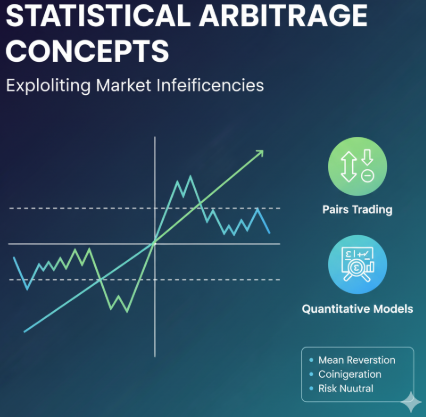
- Mean Reversion: The idea that prices or spreads eventually return to their average. For example, if two banking stocks diverge temporarily, a stat arb trader bets they will converge again.
- Cointegration: Unlike simple correlation, cointegration measures long-term equilibrium between assets. Two stocks may move independently day-to-day but still maintain a stable long-term relationship.
- Pairs Trading: The simplest stat arb model. Buy undervalued stock A, short overvalued stock B, when their spread deviates from historical norms.
Understanding these concepts is essential for applying statistical arbitrage in live markets. For a deeper primer, see Investopedia’s overview.
Common Statistical Arbitrage Strategies
Professional traders use multiple statistical arbitrage strategies beyond pairs trading. Some examples include:
- Market Neutral Portfolios: Long and short positions balance exposure, so profits depend on relative moves rather than market direction.
- Spread Trading: Exploiting price differences between index futures and baskets of constituent stocks (index arbitrage).
- ETF vs Stock Arb: Taking advantage of price gaps between ETFs and their underlying securities.
- Multi-factor Stat Arb: Using factors like momentum, volatility, and valuation to build diversified portfolios.
Benefits of Statistical Arbitrage
- 📊 Market Neutral: Returns don’t depend on bull or bear markets.
- 🤖 Quantitative: Strategies are rule-based, reducing emotions.
- 💡 Diversification: Multiple pairs or baskets spread risk.
- ⚡ Efficiency: Captures tiny mispricings at scale with automation.
Risks & Challenges in Statistical Arbitrage
No strategy is risk-free. Stat arb faces challenges such as:
- Model Risk: Relationships may break down in crises.
- Execution Costs: High-frequency trading requires low latency and minimal slippage.
- False Cointegration: Statistical tests may give misleading signals.
- Regulatory Changes: Exchanges and SEBI frequently update rules that can impact arbitrage opportunities.
Real-World Examples & Use Cases
Example 1: A trader notices HDFC Bank and ICICI Bank usually trade within a 5% spread. When the spread widens to 12%, they buy HDFC and short ICICI, betting convergence. Example 2: Arbitraging Nifty futures vs spot index values on NSE. Example 3: ETF vs stock basket arbitrage. These highlight how statistical arbitrage can be applied from equities to derivatives and ETFs.
Steps to Build a Statistical Arbitrage Model
- Choose asset universe (stocks, ETFs, indices).
- Run cointegration/mean reversion tests.
- Define entry/exit thresholds for spreads.
- Backtest strategy with historical data.
- Simulate transaction costs and slippage.
- Deploy in live market with risk controls.
| Step | Purpose |
|---|---|
| Backtesting | Test robustness on past data |
| Risk Management | Avoid overexposure to a single pair |
Statistical Arbitrage in India’s Stock Market
In India, statistical arbitrage opportunities are rising with high liquidity in Nifty, Bank Nifty, and large-cap stocks. Algo traders use co-location facilities at NSE for execution. Retail traders can also explore simplified pairs trading through brokers offering API access. However, margin and compliance rules under SEBI must be followed strictly. For practical insights, see our own guide on How Arbitrage Works in Indian Stock Market 2025.
How Trading Shastra Teaches Statistical Arbitrage
At Trading Shastra Academy, statistical arbitrage isn’t just theory — it’s hands-on. Our flagship programs train students on identifying cointegration, running mean reversion models, and executing stat arb strategies in live markets. With internship certification and capital-backed practice accounts, learners build real confidence before trading independently. Courses include mentoring, backtesting labs, and access to algorithmic trading modules.
Frequently Asked Questions
What is statistical arbitrage?
It is a quantitative strategy that uses statistical models to exploit temporary price inefficiencies between related assets.
Is statistical arbitrage risk-free?
No. Unlike pure arbitrage, stat arb involves model risk, execution costs, and market shocks that can break relationships.
What is the difference between correlation and cointegration?
Correlation measures short-term co-movement, while cointegration ensures a long-term equilibrium relationship.
Can retail traders do stat arb?
Yes, using APIs and backtesting tools. But institutional players have speed advantages in execution.
Which markets allow statistical arbitrage?
Stat arb works in equities, ETFs, futures, options, and forex where correlated instruments exist.
🚀 Want to master statistical arbitrage with live practice? Join Trading Shastra Academy for internship certification, mentorship, and funded training accounts.
Explore CoursesEmail: info@tradingshastra.com
Phone: +91 9717333285
This blog is for educational purposes only. Stock market investments are subject to risks. Please do thorough research before investing.