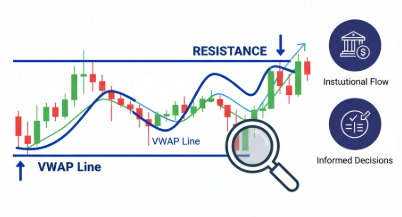
VWAP: Institutional Indicator for Smart Trading 2025
Quick summary: VWAP (Volume Weighted Average Price) is the institutional benchmark that reveals where smart money executes trades. This comprehensive guide explains what VWAP is, why institutions use it, VWAP vs moving averages, intraday setups, proven strategies (reversion, breakout, anchored VWAP), practical examples for Indian markets, and how to apply VWAP safely with strong risk rules.
What is VWAP?
VWAP — Volume Weighted Average Price — represents the average price at which a security has traded during a session, weighted by volume. Calculation: sum(price * volume) / sum(volume) for the period (typically intraday). Unlike simple moving averages that treat each bar equally, VWAP gives more importance to high-volume price periods, making it a closer proxy for where real money executed.
VWAP updates throughout the day and resets each session, creating a dynamic fair-value line. Early-session VWAP is noisy (low cumulative volume); reliability improves after 30–60 minutes as volume accumulates. Institutions use VWAP both as a benchmark and as an execution guide — algorithms aim to achieve prices near or better than VWAP to minimize market impact and show performance against a recognized standard.
Why VWAP is Called the Institutional Indicator
Institutions manage large order sizes and cannot execute them at once without moving prices. They split orders and use execution algorithms (VWAP & TWAP) to complete trades across the day. VWAP functions as the natural benchmark for these algorithms because it reflects the average execution price weighted by where volume actually occurred.
When price trades consistently above VWAP on significant volume, it typically signifies buying pressure from institutional participants. Conversely, persistent price below VWAP suggests distribution. Retail traders who learn VWAP can see where smart money is accumulating or distributing and align their trades rather than fight the flow.
VWAP vs Moving Average — Key Differences
Although VWAP and moving averages both smooth price data, they serve different purposes:
Weighting: VWAP weights by volume; moving averages weight by time (equal per period).
Reset: VWAP resets daily; moving averages carry across sessions.
Use cases: VWAP = intraday fair value & execution benchmark; MA = trend identification over multi-session horizons.
Responsiveness: VWAP reacts immediately to large-volume events; MAs smooth over them.
For intraday institutional alignment, VWAP is superior. For swing and trend traders, MAs remain useful. Many traders combine both: VWAP for session bias, MA for multi-day context.
How to Use VWAP in Intraday Trading
VWAP offers three primary intraday roles: bias filter, support/resistance, and mean reference.
Bias filter: Price above VWAP = bias to buy (with caution); price below VWAP = bias to sell.
Support/resistance: Pullbacks to VWAP often find institutional bids or offers. A defended VWAP on pullback is a green light to add in the direction of the trend.
Reversion trades: When price deviates substantially from VWAP (e.g., >1–2%), consider contrarian reversion trades when volume and context support it.
Pro tip: wait 30–60 minutes for VWAP to stabilize, confirm volume context, and use intraday timeframes (5m–30m) for entries. Always combine VWAP signals with price structure and volume confirmation — VWAP alone is not a trade trigger.
VWAP Trading Strategies (Practical Setups)
VWAP Reversion Strategy
Entry: Price deviates 1–2% (or security-specific threshold) from VWAP and shows exhaustion (falling volume on continuation or a reversal candle with increased volume). Stop: beyond recent extreme or +50–100% of deviation. Target: VWAP or partial profit earlier for conservative approach.
VWAP Breakout Strategy
Entry: Price closes above/below VWAP with volume > 150–200% of recent average and a confirmation candle (close beyond VWAP). Stop: back below VWAP or swing low. Target: measured moves or technical S/R levels. Use during trending sessions and around catalysts.
Anchored VWAP Analysis
Anchored VWAP starts calculation from a specific event (earnings, major breakout). It reveals institutional cost-basis since that event and is powerful for swing trades — institutions often defend anchored cost areas. Use multi-timeframe anchored VWAPs to gauge positional conviction.
Benefits of VWAP
Institutional alignment: trade with the flow rather than against large players.
Execution quality: benchmark to measure fills and algorithmic performance.
Dynamic S/R: VWAP adapts to real-time volume, usually more meaningful than static lines.
Improved timing: better entries on pullbacks to VWAP or push-throughs with volume confirmation.
Risk control: clearer stops and targets when you rely on institutional reference points.
Risks & Limitations of VWAP
Early-session noise: VWAP is unreliable in the first 30–60 minutes due to low cumulative volume.
Trending failure: price can remain extended from VWAP during strong trends; reversion trades can fail.
Fragmented liquidity: dark pools and off-exchange trades mean visible VWAP may miss some institutional activity.
Algorithmic probing: algorithms often test VWAP levels, creating false breaks that trap retail traders.
Overdependence: don't use VWAP in isolation — always cross-check with volume profile, order flow, and higher-timeframe context.
Tables & Quick Examples
Table 1 — VWAP vs Moving Average (at a glance)
Metric
VWAP
Simple Moving Average
Weighting
By volume
By time
Reset
Daily (intraday)
Continuous
Primary use
Execution benchmark & intraday fair value
Trend identification
Table 2 — VWAP Strategy Cheat-Sheet
Strategy
Entry
Stop
Target
Timeframe
Reversion
Price >1–2% from VWAP + reversal volume
Beyond the deviation extreme
Return to VWAP
5m–15m
Breakout
Close past VWAP + volume confirmation
Below VWAP or swing low
Measured move / S/R
15m–1h
How Trading Shastra Teaches VWAP
At Trading Shastra Academy, VWAP is taught as an institutional-grade tool — not a magic line. Our Advanced Technical Analysis & Institutional Trading modules cover VWAP calculation, anchored VWAP, VWAP algorithm behavior, and real-time trade drills. Live sessions dissect market days to show how institutions behave around VWAP and how to incorporate VWAP with volume profile & order-flow for robust setups.
Students practice with simulated execution and mentor feedback, progressing to paper trading and then to funded practice accounts for qualified participants. If you want to apply VWAP in options or equities execution, see our program details and upcoming live cohorts.
VWAP = Volume Weighted Average Price. It shows the average price of trades weighted by volume for the day and serves as an institutional benchmark and intraday fair-value reference.
When should I use VWAP vs moving averages?
Use VWAP for intraday execution, bias, and mean-reversion trades. Use moving averages for multi-day trend context. Combine both for stronger setups.
Is VWAP reliable in Indian markets?
Yes for liquid stocks and indices (Nifty 50, Nifty 500). Ensure you use exchange-verified trade volume (NSE/BSE) and avoid illiquid small-cap names where VWAP can mislead.
Can VWAP be anchored to events?
Yes — anchored VWAP from earnings or major news shows institutional cost-basis since that event and is highly useful for swing/position trades.
Should beginners use VWAP immediately?
Beginners should learn VWAP basics, practice in simulators, and wait for stable VWAP readings (30–60 minutes). Start with small position sizes and clear risk rules.
Want to trade like institutions? Join Trading Shastra Academy for live VWAP labs, order-flow mentorship, and hands-on execution training.