- Sector -2, B Block Noida-201301
- tradingshastraacademy@gmail.com
What is Delivery Trading? — Complete Guide to Delivery Trading in India (2025)
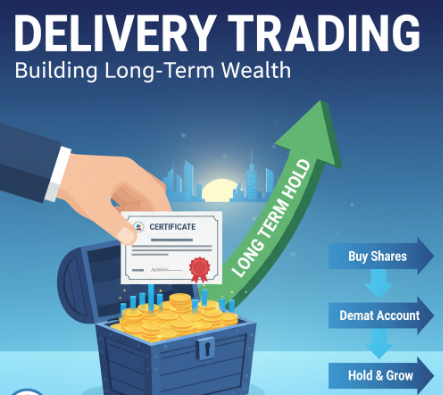
Delivery Trading Meaning & Process
Delivery trading means you buy shares today and hold them beyond the trading day. Instead of squaring off like intraday, the shares are transferred to your Demat account during the settlement cycle (currently T+1 in India as per SEBI guidelines).
Example: If you buy 50 shares of Infosys at ₹1,500 today, they will reflect in your Demat account by the next working day. You can sell them after 2 days, 2 months, or even 5 years — the choice is yours.
That’s why delivery trading is considered investment-oriented, while intraday is more speculative.
Delivery Trading vs Intraday Trading
Here’s a clear comparison to help you understand the difference between delivery and intraday:
| Aspect | Delivery Trading | Intraday Trading |
|---|---|---|
| Holding Period | Unlimited — days, months, years | Only within the same day |
| Ownership | Yes, shares credited to Demat | No actual ownership |
| Leverage | Full payment required | Leverage available |
| Tax Treatment | Capital Gains (Short-term / Long-term) | Business Income |
How to Start Delivery Trading in India
- Open a Demat + Trading Account with a SEBI-registered broker.
- Complete your KYC (PAN, Aadhaar, Bank details).
- Transfer funds to your trading account.
- Select the stock you wish to buy.
- Choose “Delivery / CNC” option when placing your order.
- Pay the full value. Shares will be delivered into your Demat within T+1 working day.
Tip: Always double-check the order type — many beginners mistakenly place intraday orders when they intend to do delivery.
Rules, Settlement & Charges in Delivery Trading
Key points to remember before you start:
- Brokerage Fees — flat or percentage depending on broker.
- DP Charges — typically ₹15–₹25 per script when you sell.
- STT — Securities Transaction Tax applied on buy & sell.
- Exchange Fees — NSE / BSE transaction charges.
- GST — charged on brokerage + fees.
India now follows a T+1 settlement cycle. So if you buy a stock on Monday, it is delivered into your Demat account by Tuesday.
Benefits of Delivery Trading
- Long-term wealth creation — ideal for building portfolios.
- Ownership benefits — eligible for dividends, bonuses, rights issues.
- Less stress — no need to monitor minute-by-minute movements.
- Better tax treatment — taxed as capital gains, not business income.
- Beginner friendly — less risky than margin-based intraday trades.
Risks of Delivery Trading
Delivery is safer than intraday, but it still has risks:
- Market Risk: prices may fall after you buy.
- Capital Lock-in: money gets tied up until you sell.
- No leverage: full payment required for every trade.
- Opportunity cost: while holding, you may miss faster opportunities.
Learn Delivery Trading with Trading Shastra Academy
At Trading Shastra Academy, delivery trading is taught not just as a concept, but as a strategy. Our students practice in real markets with academy-backed capital. We provide mentorship, risk management training, and even cover all losses during the program.
| Program | Capital Support | Monthly Stipend | Certification |
|---|---|---|---|
| Ultra Supreme Trader | ₹50,00,000 | ₹15,000 | Verified Internship Certificate |
| Supreme Trader A | ₹25,00,000 | ₹11,000 | Verified Internship Certificate |
| Supreme Trader B | ₹10,00,000 | ₹5,500 | Verified Internship Certificate |
Frequently Asked Questions
Is delivery trading safe?
Yes, it is generally safer than intraday since you own the shares and are not forced to square off. However, stock prices can still fall, so risk management is important.
Do I need a Demat account?
Yes. Without a Demat account, delivery trading is not possible, since shares must be credited there after settlement.
What is the settlement cycle?
As per SEBI, settlement is on a T+1 basis. If you buy shares today, they are delivered into your Demat account the next working day.
Is delivery trading good for beginners?
Absolutely. It is beginner-friendly, less stressful, and helps you learn stock markets with real ownership.
Want to build real wealth through delivery trading? Join Trading Shastra Academy and learn with capital-backed practice, expert guidance, and risk-covered mentorship.
Enroll NowEmail: info@tradingshastra.com
Phone: +91 9717333901
This blog is for educational purposes only. Stock market investments are subject to risks. Please do thorough research before investing.